



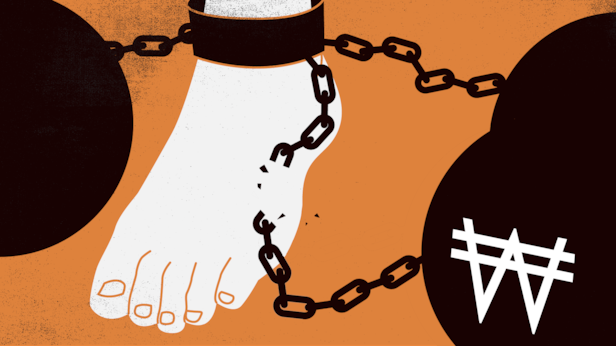
“I don’t have money to give. Just go back.”
On the 19th of last month at 2 p.m., Park, 49 years old, who lives in an apartment in Seoul’s Seongdong District, opened the door in a running shirt after hearing the doorbell. The visitor was Lee, 64 years old, a debt collector. Park had borrowed 80 million Korean won from a bank several years ago and had not repaid it for over a year and a half. When Lee asked, “What are your plans to repay in the future?” Park smiled and replied, “I will apply for personal rehabilitation.”
President Lee Jae Myung criticized some debt collection practices as “primitive predatory finance” during last month’s Cabinet meeting. The remark implied that some lenders harshly demand repayment without considering the debtor’s ability to pay. In reality, some debt collectors have illegally harassed debtors to the point of driving them to take their own lives.
According to the financial sector, there are about 8,000 debt collectors like Lee who are based on the Credit Information Act. Debt collectors recently interviewed by this newspaper expressed concern that the unreasonable illegal collection practices of some lenders could negatively affect public perception of them.
A woman in her 30s found dead in a motel in Seoul’s Dongdaemun District on April 1 of last year was revealed to have received excessive debt repayment demands from a lender before her death. Debtors suffering from illegal collection practices unanimously say, “We are tormented by debt demands.”
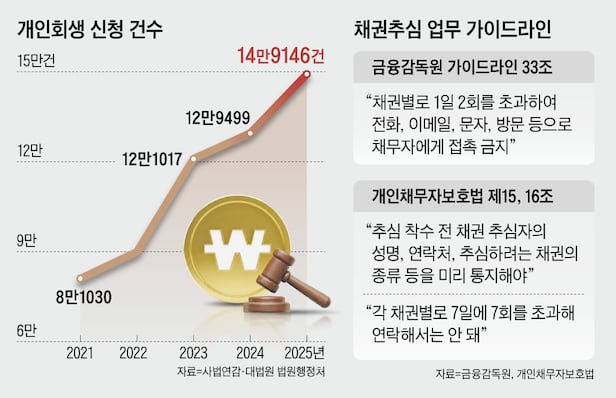
All such debt collection practices are illegal. The Individual Debtor Protection Act specifies the rules debt collectors must follow. Debt collectors can contact debtors a maximum of seven times per week through calls, texts, or visits, and can visit only once a day. Additionally, they must not contact debtors in any way from 9 p.m. to 8 a.m. the next day. Knocking loudly on the debtor’s door or shouting when visiting their home is illegal.
This newspaper accompanied a debt collector visiting a debtor on the 19th of last month. They are collectors who passed the nationally certified credit manager qualification exam, completed training, and are registered with the Financial Services Commission. Kim, a five-year veteran debt collector, visited an apartment in Seoul’s Dongdaemun District that day but was blocked at the entrance of the first-floor shared lobby. He called via the interphone installed in the shared lobby, but the debtor did not open the door. After waiting for 15 minutes, Kim followed another resident entering and pressed the debtor’s doorbell, but only received the reply, “Stop bothering me and leave.”
Kim said, “Usually, out of 100 visits, only one or two debtors open the door,” and added, “Cases where they avoid contact or threaten to report us for illegal collection have increased compared to before.” That day, Kim called 11 debtors but had no success. They delayed or refused repayment, citing reasons like, “The money was automatically withdrawn,” “I will borrow money and deposit it in the evening,” or “My salary will be deposited tomorrow.”
As the issue of debtor protection has recently gained social attention, the position of debt collectors has become even more constrained. Most debt collectors sign contracts with collection agencies for periods of three to six months and receive 15–30% of the recovered amount as a success fee upon successful collection. However, on the 28th of last month, the Financial Services Commission announced that it would switch the debt collection business from a registration system to a permit system. As a result, the over 900 current collection agencies are expected to be reduced to around 30. Recently, A Credit Information Company, a subsidiary of one of the four major financial groups, introduced a “cut-off system” where debt collectors are fired every three months based on performance.
Recently, individual and small business debts have been decreasing. This is due to the government’s successive debt relief measures. In October of last year, the government established the bad bank ‘New Leap Fund’, which forgives debts that are over seven years old or under 50 million Korean won. Through this, 1.23 million individuals and small business owners had 22.6 trillion Korean won in debt forgiven. However, Choi, a seven-year veteran debt collector, said, “One debtor with over 1 billion Korean won in arrears was serving as the chairman of a regional university,” and asked, “Shouldn’t debt relief be withheld for debtors who have the financial means but refuse to repay?”
Professor Choi Chul from the Consumer Economics Department at Sookmyung Women’s University said, “While debtor protection measures are necessary, the legitimate rights of creditors must also be guaranteed,” and emphasized, “It is important to create an environment where debtors can repay their debts.”
