




There are three real paths. You can build your own AI collector. You can license a platform and run it yourself. Or you can outsource your collections to an agency that runs AI natively. Each one comes with a different cost, a different operational reality, and a different set of tradeoffs.
This guide walks through all three models.
Current state of AI debt collectors
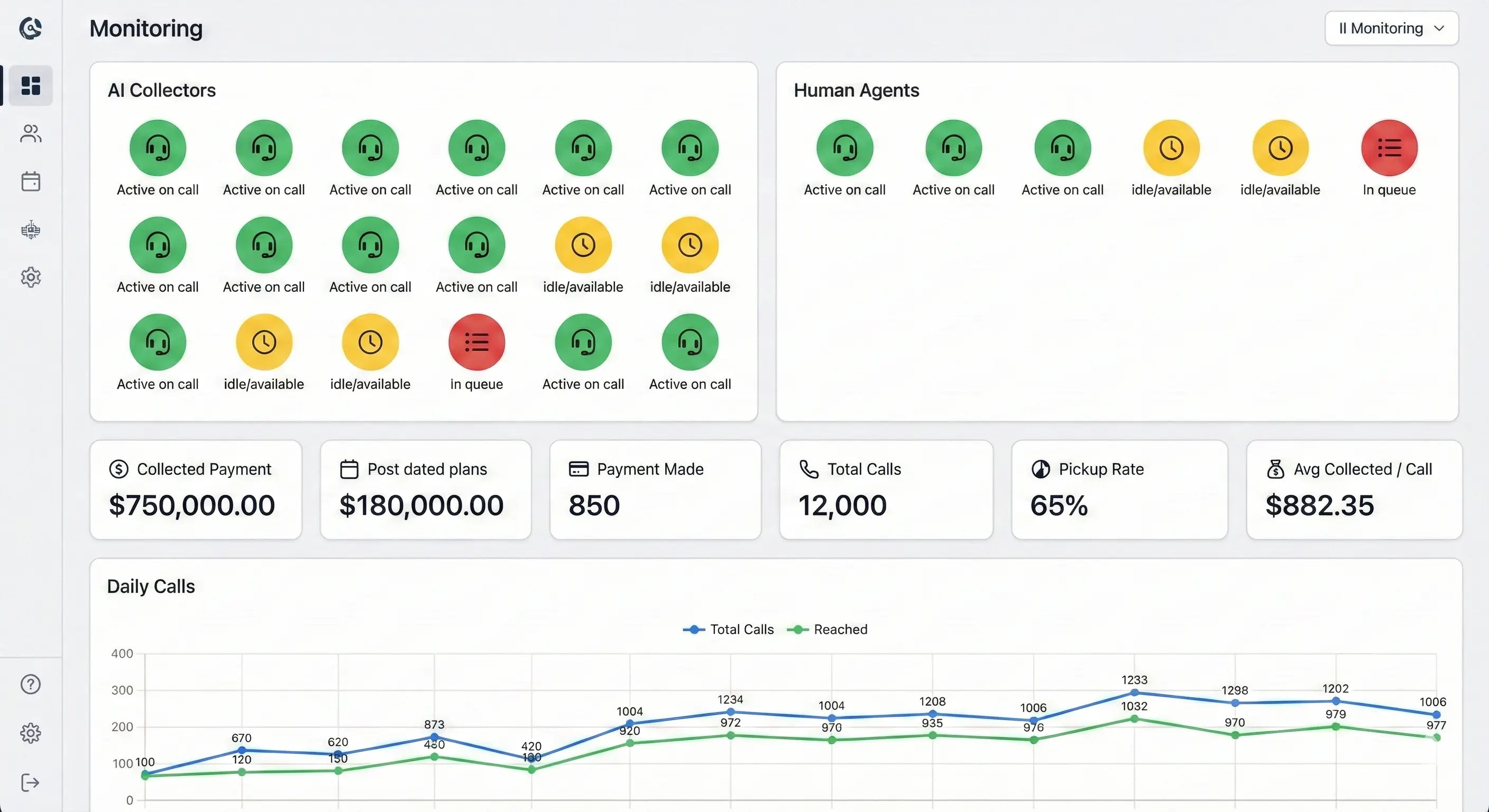 AI collectors handle collections conversations end-to-end. They greet consumers, verify identity, explain the debt, negotiate payment plans, and process payments.
When properly integrated, they connect to your CRMs, dialers, payment portals, and lending systems. The AI has the consumer’s full picture the moment a call connects—balance, payment history, available options.
Every interaction is recorded, transcribed, and summarized, with outcome data flowing back to your systems in real time.
Properly built AI collectors operate within FDCPA, TCPA, and state-level regulations, handling call time restrictions, mini-Miranda disclosures, and opt-out requests.
How collections teams are using AI today
Collections teams use AI for:
- Payment calls
- Answering routine questions
- Routine tasks like changing payment dates or methods
- Dispute intake
- After-hours coverage
- Voicemail drops and payment reminders
Some use it as a first line of service, delivering fully human-like experiences from the first second of the call.
Option 1: Build your own AI collector
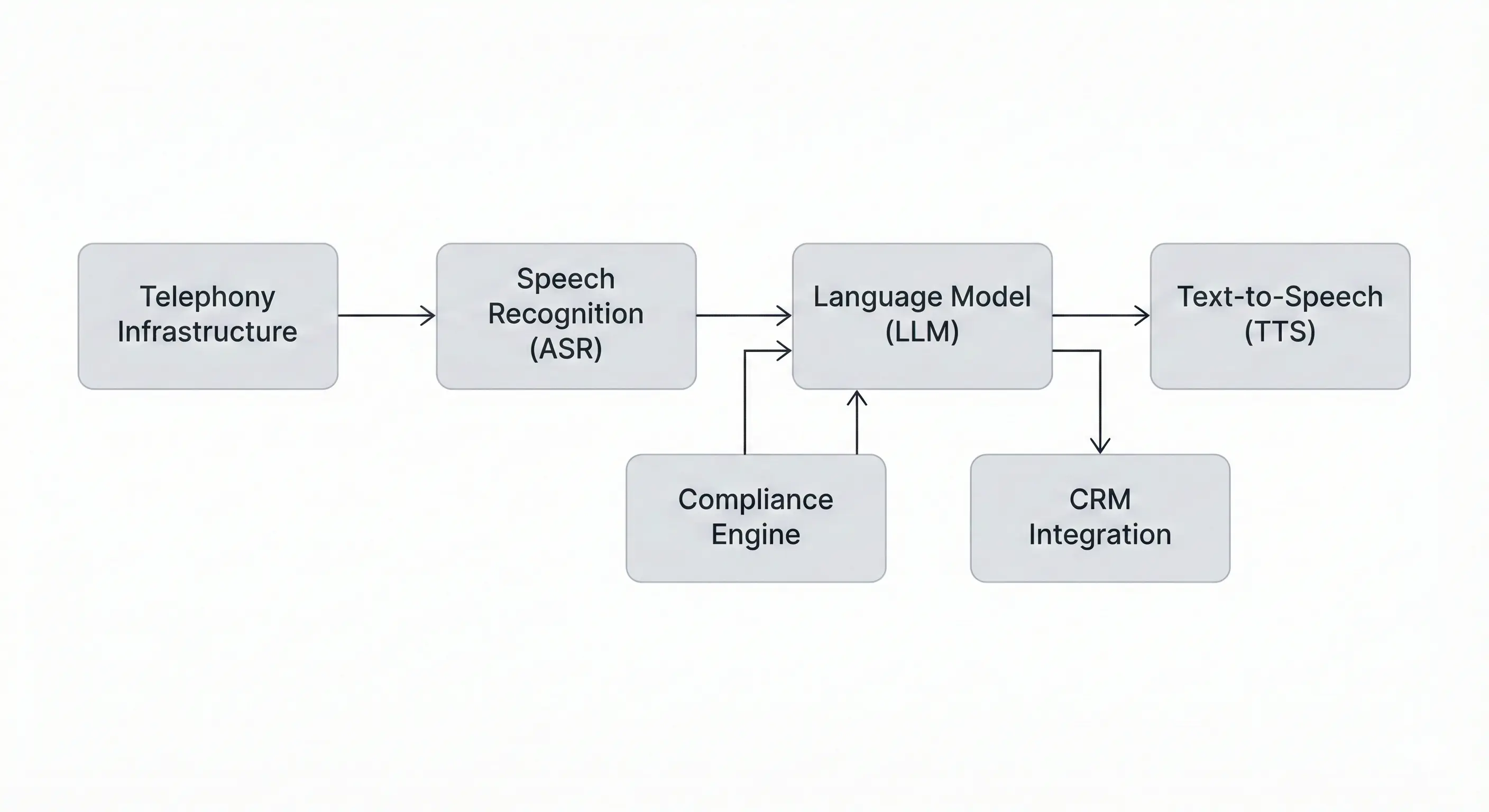 Building an AI collector means assembling multiple components:
- Telephony infrastructure: Your system needs APIs that pass call audio in real time.
- Speech recognition (ASR): Converts spoken words to text and handles accents, noise, and poor connections.
- Language model (LLM): Decides how the AI responds. You can fine-tune GPT, Claude, or Gemini, or build custom from scratch.
- Compliance engine: Enforces FDCPA, TCPA, and Reg F through automated handling of call time restrictions, required disclosures, opt-outs, and bankruptcy flags.
- Text-to-speech (TTS): Converts the AI’s responses into spoken words.
- CRM and payment integrations: Pull account data, process payments, and push outcomes back after every call.
- Training data: Thousands of recorded, transcribed collections calls to teach the model how to handle different scenarios.
What it costs
Costs vary based on whether you use open-source or commercial APIs, build or license compliance logic, and how many integrations you need.
You need AI engineers who understand both technical architecture and the collections domain. Dedicated headcount for build, launch, and ongoing maintenance.
Timeline
6 to 12 months from scoping to production.
The ongoing commitment
You own uptime, call quality, compliance updates, and model performance. When regulations change, you update the logic. When integrations break, you fix them. When the AI needs retraining, that’s internal work. Full control, full responsibility.
Option 2: License AI debt collectors
 The vendor provides the AI stack: speech recognition, language model, text-to-speech, telephony, and compliance guardrails. They maintain the infrastructure and handle updates.
Integration with your CRM, dialer, and payment systems happens through pre-built connectors or APIs. Implementation is included but you pay $10K+ upfront to get live.
Your team coordinates between the AI vendor and your other technology providers during setup, configures how the AI operates (call strategies, payment terms, escalation rules, compliance boundaries), reviews calls and feeds corrections back to the vendor, and runs campaigns.
What it costs
- Upfront implementation/platform fee: $5k onwards
- Usage: $0.40 to $1.00 per minute of talk time
Some vendors offer subscriptions or hybrid models. Performance-based pricing exists but is rare.
Timeline
6 weeks to several months from contract to pilot, depending on system compatibility and data quality.
The tradeoff
The vendor bills by the minute. You optimize for dollars collected. That misalignment shapes how much ongoing optimization actually happens. You get the technology without building it, but you still run the operation.
Option 3: Outsource to an AI-native agency
 Instead of building or licensing AI, you place debt portfolios with an agency that runs AI collectors natively. Same model as traditional outsourcing, different technology.
How it works
The agency holds the collections license and operates the AI. You place accounts on contingency. They work the portfolio using AI voice agents, SMS, and email. You get reporting and performance data.
No integration required. No implementation timeline. No platform to configure or maintain.
What you pay
Contingency only. Typically 15% to 35% of dollars collected, depending on portfolio age and type. Same range as traditional agency placement.
Timeline
Most agencies can start working accounts within a few weeks of portfolio placement.
The different incentive structure
The agency only earns when you collect. They optimize for the same outcome you do: dollars recovered.
This changes what they invest in. Traditional vendors move on after implementation. AI agencies iterate daily because better performance directly increases their revenue.
What you give up
Control: You are not configuring the AI or reviewing calls. You get performance reporting, but you do not touch the operation.
Internal learning: Your team does not build AI expertise. You are outsourcing the work, not bringing the capability in-house.
What you keep
Portfolio ownership: The agency works your accounts, but you still own the debt and the consumer relationship.
Flexibility: If performance does not meet expectations, you pull the accounts and place them elsewhere. No long-term platform contracts.
The tradeoff
Lower risk, less control. You are not building infrastructure or paying for minutes logged. But you are also not developing internal AI operations capability.
How to decide
BUILD |
LICENSE |
OUTSOURCE |
|---|---|---|
| You have budget for 6–12 month development cycles | You want AI technology without building it | You want to test AI with zero upfront investment |
| You have AI engineers who want to work in collections | You have budget for upfront implementation and per-minute usage | You do not have technical resources for integration and maintenance |
| You need full control over the AI’s behavior and data | You have technical resources to manage vendor coordination and ongoing configuration | You optimize for speed to market (days vs. months) |
| You are building long-term competitive advantage through proprietary technology | You want to keep the operation in-house while leveraging vendor technology | You are comfortable with contingency economics and less operational control |
The best operations combine AI with human collectors. AI handles high-volume routine work. Humans handle high-value complex cases. How you deploy AI matters less than how you use it alongside your team.

Aman Mender
