

 The exchange for the debt economy
Source: site
Five years after the US Department of Agriculture (USDA) guaranteed more than $100 million to what’s billed as the “world’s largest manure biogas project”, the loans are in delinquency, which, along with operational failures and underperformance at such plants, has seemingly prompted an agency-wide pause on loan guarantees for such projects, according to The New Lede’s analysis of federal data.
The failure by plant owners to pay back taxpayer-backed loans comes as projects that turn animal waste into alternative fuel are under heightened scrutiny amid complaints from health and environmental advocates that the plants are incentivizing more polluting at large-scale animal production.
Such digesters are increasingly common in the US to deal with the massive amounts of waste generated at large-scale livestock and dairy farms. Digesters use bacteria to break down large amounts of animal manure and turn it into “biogas,” which is a mix of mostly methane and carbon dioxide and used in some vehicles and as a natural gas substitute.
A January USDA directive, which started a three-month pause on loans aimed at promoting anaerobic digesters and was sent to all members of the agency’s rural development team, said 27% of the department’s loan totals for such projects were in delinquency. The directive cited $102.6 million in delinquent loans for anaerobic digesters but did not name the companies in delinquency.
However, data from the USDA’s Lender Lens portal shows four anaerobic digester loans in delinquency that total $102.6 million — with $100.1 million of the delinquent loans belonging to the Wisconsin biogas project called BC Organics, via two loans awarded in 2021 during the Biden administration.
BC Organics is between 181 and 360 days delinquent on the loans, which were originally for more than $104 million combined. The only other USDA loans for anaerobic digester projects in delinquency are $891,179 for Dovetail Energy LLC in Ohio, and $696,492 for Ringler Energy LLC in Ohio, according to the portal.
Last July BC Organics combined with two other companies, Dynamic Renewables and National Organics, to form Sagepoint Energy LLC, which is heavily invested in renewable natural gas (RNG) facilities — both manure- and landfill-generated.
In addition to loan delinquency, the USDA directive also said the agency’s “internal portfolio data indicates elevated rates of project underperformance … and operational failure.”
BC Organics received the two loans totaling $104 million — with 80% guaranteed — from the USDA’s Rural Development’s Biorefinery, Renewable Chemical, and Biobased Product Manufacturing Assistance program to build 16 manure-to-gas digesters and process an estimated one million gallons of manure per day from 11 Wisconsin dairy farms. The digester facility was completed in 2022, according to a press release that said the total project cost was more than $140 million.
The USDA would not confirm that the four loans totaling $102.6 million were the ones that, in part, prompted the January directive. An agency spokesperson said “beyond information that the agency already publishes, we cannot confirm the delinquency status of specific loans … portfolio data changes with time and depends on which programs are included,” and added that the agency is working with lenders to service the loans.
While BC Organics’ loans are among the largest individual loans in delinquency, according to the portal, other programs and companies have higher delinquency totals. For example, RYZE Renewables Las Vegas LLC didn’t pay back more than $270 million that it received in 2018 to develop renewable diesel fuel. The company filed for bankruptcy in 2023.
The USDA spokesperson said the agency will be examining the high rates of delinquency for loans aimed at renewable diesel projects as well.
“This effort is part of an ongoing review of spending,” the spokesperson added. “We are stewards of taxpayer dollars, and President Trump has made it a priority to eliminate wasteful spending across the federal government.”
“We are stewards of taxpayer dollars, and President Trump has made it a priority to eliminate wasteful spending across the federal government.” – USDA spokesperson
Neither Sagepoint Energy nor its owner, the investment firm Ares, responded to requests for comment on the delinquent loans.
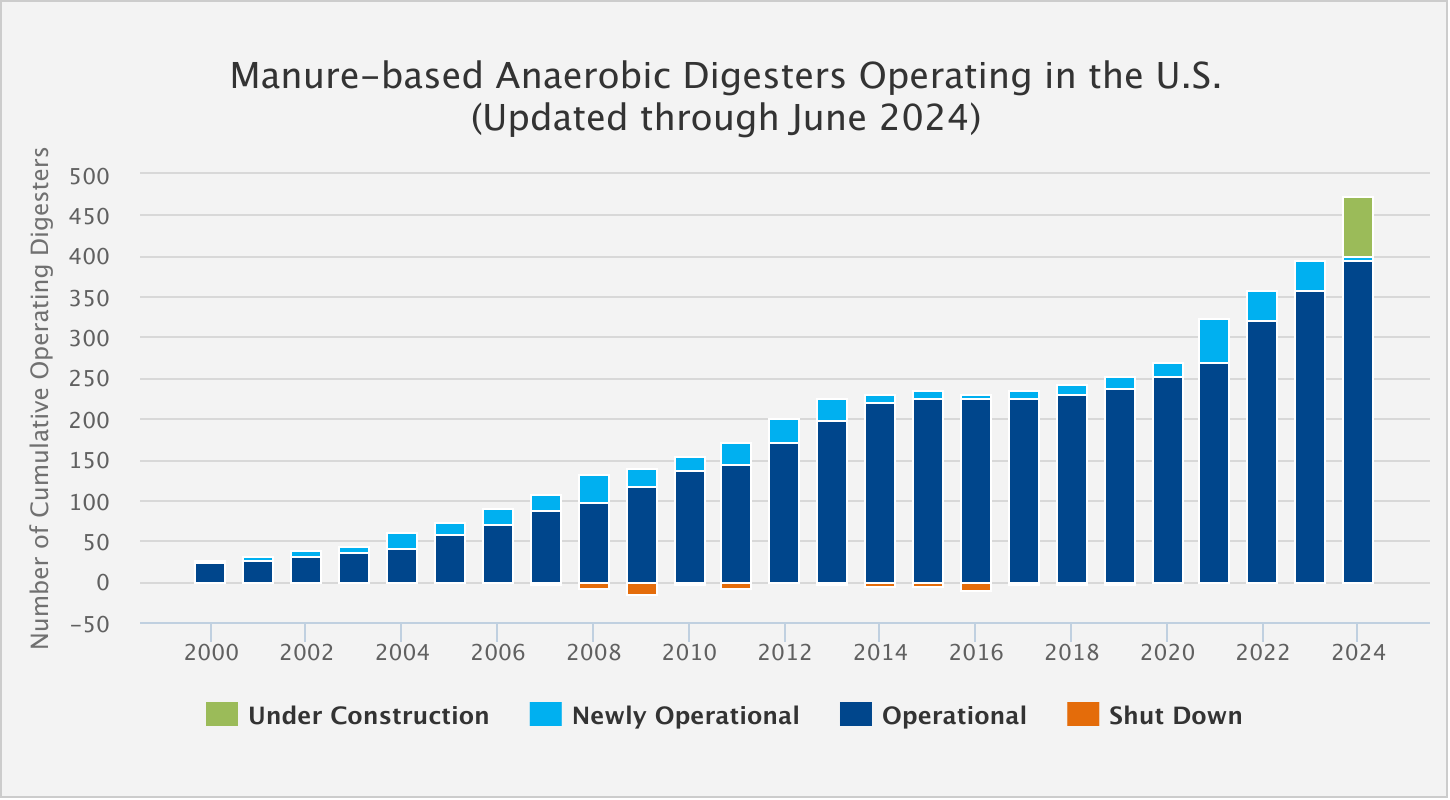
The USDA directive last month came as manure-to-gas digesters have been increasing in the US. There are an estimated 394 manure-based digesters operating in the US, with more than 70 under construction, representing a 55% increase over the past decade. The USDA pause is important as federal support, along with low-carbon fuel standards in states like California, Oregon and Washington, remain crucial for the manure-to-gas digesters to make economic sense, according to researchers.
“The only thing that makes digesters economically viable is government support,” Aaron Smith, a researcher and professor of agricultural and resource economics at the University of California, Berkeley, said, adding that it costs 9 or 10 times as much to produce gas from a digester as it does to drill for it.
Biogas advocates say such digesters are a climate-win, reducing methane emissions and manure land applications. Manure digesters reduced greenhouse gases by more than 13 million metric tons in 2023, according to the most recent data available from the US Environmental Protection Agency (EPA).
But critics say the use of farm digesters incentivizes the addition of animals to already large farms without actually providing significant environmental benefits. Last year Johns Hopkins researchers reviewed the literature on manure digesters and found that, when spread on fields, digestate can contaminate local waterways with phosphorus, nitrogen and pathogens.
“The public money going to these digesters is just giveaways to an industry that is very good at capturing public subsidies,” said Andrew deCoriolis, the executive director of Farm Forward, adding that many of the early manure digesters were at smaller, family farms to generate “a little bit of electricity to power their barns.”
“These are not the ones that we’re describing now. This is now just a tool for industrial-scale waste management,” deCoriolis said.
The USDA pause on manure digester loans, which began in mid-January, will last at least 90 days or “until further guidance has been directed,” according to the directive. The pause also halted loans for “controlled environment agriculture” — such as vertical farming, hydroponics, aeroponics and aquaponics. The USDA said of the $311.9 million of controlled environment agriculture loans in their portfolio, 43%, or $135 million, is currently delinquent.
Featured image: Secretary of Agriculture Brooke Rollins speaking at a ribbon-cutting event in February. (Credit: USDA)
Upcoming Events
